7 Steps to Interpret NFL Pass Rush Win Rate

Last Updated: October 29, 2026
Quick Summary
Pass rush win rate is the share of a rusher's pass-rush snaps in which he beats his blocker within 2.5 seconds of the snap, regardless of whether the play ends in a sack. It measures process rather than results, so judge the wins instead of the box score.
- Every win is judged against a 2.5-second window from the snap, roughly how long a quarterback holds the ball.
- The math is wins divided by pass-rush snaps, though grading standards vary slightly between data providers.
- Check the denominator first: 60 pass-rush snaps is a small-sample curiosity, while 400 is a real dataset.
- Double-team rate is the most underused context clue because double teams suppress raw win rates.
- Win rate stabilizes over a season, not a weekend, so do not treat a hot two-game stretch as a breakout.
Table of Contents
- What Pass Rush Win Rate Actually Measures
- How Pass Rush Win Rate Is Calculated
- Pass Rush Win Rate vs. Sacks: Why the Numbers Disagree
- Reading NFL Pass Rush Win Rate Rankings Without Getting Fooled
- Pass Block Win Rate: The Other Half of the Matchup
- A Step-by-Step Guide to Interpreting One Player's Rate
- Context That Changes the Number: Position, Role, and Opportunity
- Sample Size, Stability, and What the Metric Can't Tell You
- Turning the Number Into a Decision
- Frequently Asked Questions
What Pass Rush Win Rate Actually Measures
Pass rush win rate is the share of a rusher's pass-rush snaps in which he beats his blocker within a set time limit, regardless of whether the quarterback is sacked. That last part matters most. This number is a measure of process, not results.
The metric answers one question: how often does a rusher win his individual matchup? It does not ask whether the play ended in a sack, a hurry, or a quick throw that erased the pressure entirely.
That distinction is the whole point. Sacks are loud. Wins are quiet.
The 2.5-Second Evaluation Window
Every pass-rush win gets judged against a clock. The standard window is 2.5 seconds from the snap. Beat your man inside that window and you log a win. Get home at 3.1 seconds and it may still be a great rep, but it does not count.
Why 2.5 seconds? Because that is roughly how long a quarterback holds the ball on a standard dropback before the ball comes out. A rusher who wins after the throw has already happened changed nothing.
So the window rewards quick wins. It punishes slow ones. That is intentional.
How Pass Rush Win Rate Is Calculated
The math itself is simple: wins divided by pass-rush snaps, expressed as a percentage.
The hard part is the judgment call inside it. Someone has to watch every rep and decide who won. That is why the number varies slightly between data providers. Different graders, different standards.
Here is what typically counts:
- A clean win off the edge before the clock hits 2.5 seconds
- A power move that collapses the pocket inside the window
- A stunt or twist that gets a rusher free to the quarterback
And what usually does not:
- A pressure created after the ball is out
- A sack that comes from coverage holding up for four seconds
- A rusher pushed wide and out of the play
What Counts as Beating a Block
Beating a block means gaining a clear advantage over the blocker, not just touching the quarterback. A rusher who forces the passer to step up early has won the rep even without contact.
Watch out: the most common mistake is crediting a rusher for a sack he only got because the quarterback held the ball too long. That is a coverage win wearing a pass-rush costume.
Pass Rush Win Rate vs. Sacks: Why the Numbers Disagree
Sacks and pass rush win rate often tell opposite stories, and the wins usually age better. A rusher can dominate for weeks and post a low sack total. The reverse happens too.
Sacks are rare and noisy. They depend on the quarterback, the down, the score, and pure luck. A strip-sack and a coverage sack look identical in the box score.
Win rate strips that noise out. It asks whether the rusher is consistently getting home, not whether the stat sheet smiled on him.
The takeaway: judge the process, not the box score. If you want a repeatable workflow for weighing efficiency stats against matchup context, see our guide on how to analyze NFL matchup stats for betting.
Reading NFL Pass Rush Win Rate Rankings Without Getting Fooled
NFL pass rush win rate rankings are a starting point, not a verdict. A high rank tells you a rusher wins often. It does not tell you who he beat or when it mattered.
Ask three questions before trusting any ranking:
- Who did he line up against? Facing elite tackles every week is a different job.
- How many snaps? A rotational rusher with limited snaps can post a gaudy rate.
- Was he doubled? Double teams suppress raw win rates.
A rusher ranked tenth who faces constant double teams may be more valuable than a rusher ranked third who gets single blocks. Rankings hide that.
Market context matters here too. After learning that rankings can mislead, it helps to understand how NFL spreads and totals move and how the market compares with raw metric rankings.
Pass Block Win Rate: The Other Half of the Matchup
Pass block win rate measures how often an offensive lineman holds his block for the full 2.5 seconds. It is the mirror image of the pass-rush number, and it belongs in the same conversation.
You cannot judge a rusher without judging his opponent. A high pass rush win rate against a weak pass protection unit means less than a solid rate against a strong one.
The two metrics pair up like this:
| Metric | What It Measures | Side of the Ball |
|---|---|---|
| Pass rush win rate | How often a rusher beats his block | Defense |
| Pass block win rate | How often a blocker holds his rep | Offense |
| Run stop win rate | How often a defender wins vs. the run | Defense |
| Run block win rate | How often a blocker wins on run plays | Offense |
Track both sides. A matchup between a strong pass rusher and a strong pass blocker is a coin flip, not a mismatch.
A Step-by-Step Guide to Interpreting One Player's Rate
Most explanations of pass rush win rate stop at the definition and a leaderboard.
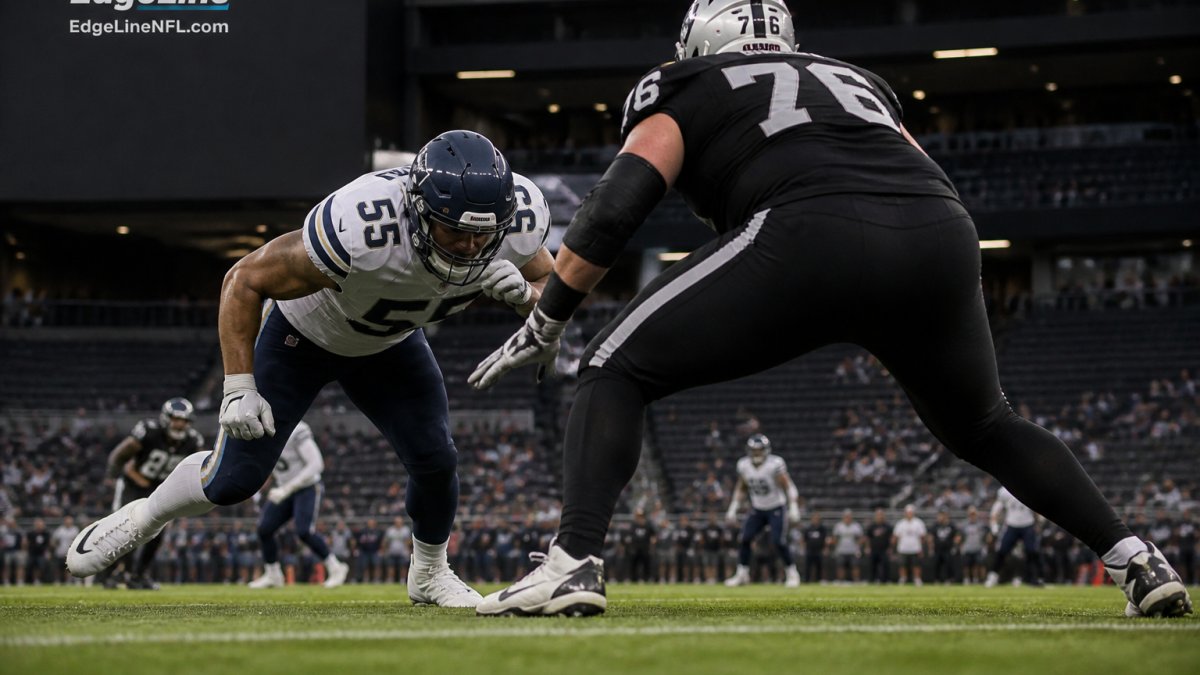
Step 1: Start with the denominator, not the percentage. A win rate is wins divided by pass-rush snaps.
Step 3: Check the double-team rate. This is the single most underused context clue.
Step 4: Look at the opponent quality. A rate built against backup tackles and tight-end chips means less than a rate built against starting left tackles.
Step 5: Compare the rate to the sack and pressure totals. A large gap between a high win rate and a low sack total usually points to one of three things: the quarterback is getting the ball out fast, the rusher is winning early but not finishing, or the coverage is forcing the passer to hold the ball and the rusher is still not converting. Each explanation implies a different conclusion about the player.
Step 6: Check the quarterback's time to throw. If the opposing passer is releasing in roughly 2.2 seconds, the 2.5-second window barely opens. A rusher can play well and still post a modest rate in that matchup. Time to throw is the context variable that most often explains a surprising number.
Step 7: Separate the season from the week. One dominant game is noise. A full season of consistent wins is signal.
That process turns a single number into a real read on player performance. To see how those wins translate into game outcomes, compare what moneyline, spread, and total markets each measure. Once you see how role and opportunity shift a player's rate, you can turn those factors into decisions with our guide on data-informed NFL matchup decisions.
Context That Changes the Number: Position, Role, and Opportunity
A pass rusher's number never exists in a vacuum. Position, role, and opportunity reshape it.
An edge rusher rushing from the outside linebacker spot sees more single blocks and more quick throws.
Role matters just as much. A rotational rusher who plays obvious passing downs gets a boost.
Scheme and play design finish the job. A defense that stunts and twists creates free rushers.
Watch out: coverage and time to throw can make a great rusher look average. If the passer is throwing in 2.2 seconds, no edge rusher wins.
Sample Size, Stability, and What the Metric Can't Tell You
This is the question that separates a casual reader from a serious one: how many pass-rush snaps does it take before a win rate means anything?
Why small samples mislead. Pass-rush wins are binary events, a rusher either wins the rep or he does not. Binary events produce streaky sequences.
Year-to-year stability. Win rate tends to hold up better than sacks from one season to the next, because it measures process rather than the noisy outcome. But it still moves.
What the metric cannot tell you. Even at full-season sample size, pass rush win rate leaves real questions unanswered:
- Whether the pressure actually affected the throw, or whether the quarterback stepped up and delivered cleanly
- How the rusher performed in the highest-leverage moments, where opponents scheme help his way
- Whether the quarterback was rattled, or whether he is simply comfortable under pressure
- How the rusher's wins were distributed, a cluster of wins in blowouts is different from wins in one-score games
That is where injury reports and weekly designations fill the gap. A reader warned about instability wants to know how to use NFL injury reports for game previews to add that missing context. And when you are weighing a metric against a market line, remember that model probability is not certainty and is not the same thing as betting value.
Turning the Number Into a Decision
Pass rush win rate is a tool, not an answer. It tells you who is winning reps. It does not tell you what the betting market already knows.
That gap is where analysis can help. Comparing a metric like this against the line is one way to evaluate a matchup.
We separate official picks from lower-confidence model leans, and we track every result in the open.
Bet responsibly. Never wager more than you can afford to lose.
Get the Edge! Subscribe Now at https://www.edgelinenfl.com.
Frequently Asked Questions
What is a good pass rush win rate in the NFL?
There is no single official cutoff, because rates shift by season, position, and sample size. The practical approach is to compare a player against others at his position in the same season and to track whether his rate holds up over multiple weeks. A rate that sits well above the positional average across a full season is a stronger signal than a hot two-week stretch. Treat any single number as a starting point for comparison, not a verdict.
How is pass rush win rate different from sacks?
A sack is a result that depends on the quarterback holding the ball, coverage behind the defense, and luck on the finish. Pass rush win rate measures whether the rusher beat his block inside the evaluation window, regardless of whether the play ended in a sack. That is why a rusher can post a strong rate with a modest sack total, or pile up sacks on a rate that does not sustain. Use both together: the rate tells you about process, sacks tell you about results.
Can pass rush win rate help evaluate an NFL matchup?
Yes, when you pair it with the opposing pass block win rate. A defensive front with a high pass rush win rate facing an offensive line with a low pass block win rate points to pressure, which can shape quarterback time to throw and play design. That said, the metric does not account for scheme, double teams, or quick game, so it works best as one input in a broader matchup model rather than a standalone pick.
What are the limitations of pass rush win rate?
The metric depends on charting judgment about what counts as a win, and it does not isolate a rusher from help. Double teams, chips, and a quarterback who gets the ball out fast can suppress a rate that would look different in another scheme. Sample size matters too: rates swing early in a season and stabilize as snaps accumulate. Treat it as a tool for context, not proof, and always check the snap count behind the percentage.
