How to Use NFL Injury Reports for Game Previews
Last Updated: October 27, 2026
Quick Summary
To use NFL injury reports for game previews, pull both teams' final reports, rank players by impact (quarterback first, then offensive line, skill players, defense), and price the backup's actual role rather than the headline. Check the report Wednesday, Friday, and on game day, then compare your injury-adjusted number to the line to see if the market already priced the news.
- Out means plan the backup in now; Doubtful is treated as Out; Questionable is the true coin flip.
- Teams file their first practice report Wednesday and a final game-status report before kickoff.
- A starting quarterback ruled Out typically moves a spread more than any other designation.
- A move crossing a key number like 3 or 7 matters more than the raw point value.
- Layer rest, travel, weather, and line movement on top of the injury report before finalizing a number.
Table of Contents
- Why Injury Reports Decide More Matchups Than You Think
- NFL Injury Report Designations Explained
- The NFL Injury Report Schedule: When to Check and Why
- A Step-by-Step Workflow for Building a Matchup Preview
- How Injuries Affect NFL Betting Lines
- NFL Matchup Analysis Tools That Handle the Heavy Lifting
- Situational Context: Rest, Travel, Weather, and Line Movement
- Build Your Injury-Aware Preview With EdgeLine NFL
- Frequently Asked Questions
Why Injury Reports Decide More Matchups Than You Think
Learning how to use NFL injury reports for game previews starts with one hard truth: the report is not a status list, it is a probability document. The report is not a status list; it is a probability document.
Here's the part most previews miss. The NFL's official injury report guidelines set the framework teams must follow, and understanding that framework is your first edge.
NFL Injury Report Designations Explained
The NFL uses four core designations, and each one signals a different level of risk. Out means the player will not play. Doubtful means unlikely, and in practice it almost always means Out. Questionable is the true coin flip. No designation means the player is expected to play.
Out, Doubtful, and Questionable: What Each One Actually Signals
- Out: Plan the backup into your projection now. No guesswork.
- Doubtful: Treat as Out until proven otherwise. Rarely active.
- Questionable: The hardest to price. Check practice participation.
The practice report matters as much as the designation. A player who practiced fully all week and is Questionable is a different bet than one who missed every session. A common mistake is ignoring the practice trend. Three limited practices trending toward full is a green light.
Each designation signals a different level of risk, and the practice report matters as much as the label.
| Designation | What it signals | How to handle it |
|---|---|---|
| Out | Player will not play | Plan the backup into your projection now |
| Doubtful | Unlikely; in practice almost always Out | Treat as Out until proven otherwise |
| Questionable | The true coin flip | Check practice participation |
| No designation | Expected to play | Confirm the final report |
The NFL Injury Report Schedule: When to Check and Why
Timing is everything with injury reports. Teams issue their first practice report on Wednesday, update it Thursday and Friday, and file a final game-status report before kickoff. That final report is the one that moves lines.
Check three times: Wednesday for the initial picture, Friday for the game-status designations, and the final report on game day for late scratches. Late-week news, especially on a quarterback, can swing a spread in minutes. If you only check once, check the final report. That is when the real information lands.
A Step-by-Step Workflow for Building a Matchup Preview
Here is a process for turning injury reports into a preview. It is built to avoid treating correlated stats as independent evidence.
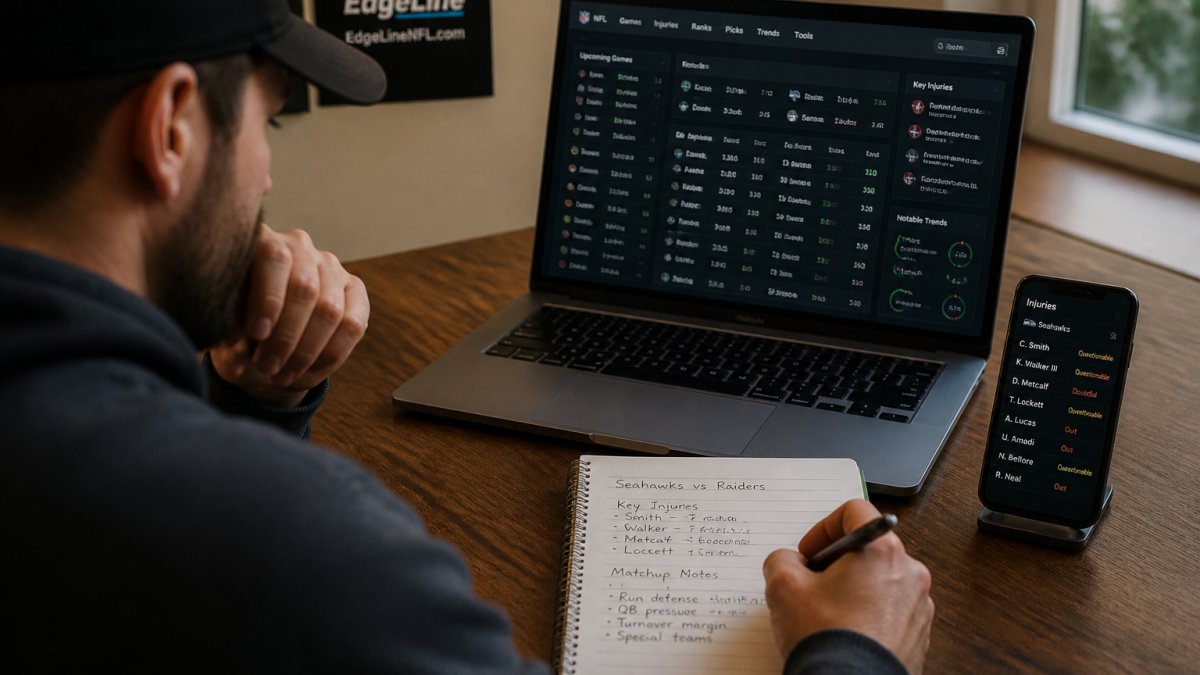
- Pull both final injury reports. List every player with a designation.
- Rank by impact. Quarterback, then offensive line, then skill players, then defense.
- Identify the replacement. A backup's role and usage tell you the real drop-off.
- Adjust efficiency for the change. Downgrade the unit that loses the starter.
- Check the line. Has the market already priced the news?
- Compare your number to the line. Only bet when you find a gap.
Compare Efficiency, Then Adjust for the Opponent
Raw efficiency lies when schedules differ. Compare each offense to what its opponents allow, then adjust for the defense it now faces. If you are new to these metrics, our guide to NFL betting metrics for beginners breaks down DVOA and efficiency stats so you know exactly what you are comparing.
Don't Double-Count Correlated Signals
This is the step most previews skip. Efficiency, scoring, point differential, and ATS record are not independent pieces of evidence, they overlap heavily. A team that ranks top-five in points per game is usually also top-five in efficiency and point differential. Counting all three as separate confirmations inflates your confidence without adding information.
A practical way to handle this:
- Pick one primary efficiency measure (EPA per play or DVOA) as your base signal.
- Use scoring and point differential as sanity checks, not as additional evidence.
- Treat ATS record as a market-relative measure, not a team-quality measure, it tells you how the team performed against expectations, which is a different question.
A Worked Example of the Adjustment
Suppose a starting quarterback is ruled Out and the backup has a lower completion rate and a higher sack rate in limited snaps. A simple adjustment: downgrade the offense's projected efficiency by a range you can defend, then re-run the matchup against the opposing defense. If your adjusted number says the team should be a 2-point favorite and the market has it at 4, you have a candidate gap, but only if the injury news is already public and the line has not fully adjusted.
Turn the Workflow Into a Number
The goal of the workflow is a single injury-adjusted number you can compare to the market. If your number and the line disagree, ask why: is the market missing the replacement's role, overreacting to a name, or pricing something you haven't accounted for? Only bet when you can articulate the reason. For a deeper walkthrough of this workflow, see data-informed NFL matchup decisions.
How Injuries Affect NFL Betting Lines
Lines move on injury news before most fans finish reading the report, but the size and direction of the move depend on the position, the replacement, and how much the market already expected the news. Understanding that mechanism is what separates a reaction from an edge.
Why Position Matters More Than Star Power
A starting quarterback ruled Out typically moves a spread more than any other single designation, because the drop-off to the backup is usually the steepest on the roster and the offense's entire play-calling changes. An offensive lineman rarely moves a spread on his own, but two or three linemen out in the same week can shift both the spread and the total.
The Key-Number Problem
NFL spreads cluster around 3 and 7 for a reason: those are the most common margins of victory. A move from -2.5 to -3.5 crosses the 3, which is worth more than a move from -4.5 to -5.5 that stays between key numbers. When injury news hits, ask two questions:
- Did the line cross a key number? If yes, the move matters more than the raw point value suggests.
- Was the move justified? Compare the opening line, the current line, and your own injury-adjusted number. If the market moved 3 points and your model says the injury is worth 1.5, the value may be on the other side.
Opening Line vs. Closing Line
The opening line reflects the market's first read on the game, often before the week's practice reports are complete. The closing line reflects everything the market learned, including final injury designations. Closing-line value (CLV) measures whether the number you bet beat the number the game closed at. A bet that beats the close by half a point on a key number is a better process signal than a bet that won on a lucky bounce.
When the Market Overreacts
The market is fast, but it is not always right. A common pattern is overreacting to a big name while ignoring a bigger structural problem, for example, a star receiver listed as Questionable drawing all the attention while two starting offensive linemen are Out. The receiver's backup may be serviceable; the line's backups may not be.
To read these shifts correctly, learn how NFL spreads and totals move and why crossing key numbers like 3 and 7 matters. Compare the opening line to the current line, and ask whether the move reflects real information or public panic. For a deeper look at how fair-line projections and CLV tracking expose real edges, see our breakdown of best NFL betting analytics platforms for line value.
NFL Matchup Analysis Tools That Handle the Heavy Lifting
You can build this by hand, but good tools save hours. NFL matchup analysis tools pull injury data, efficiency metrics, and line movement into one view so you can spot the edge faster.
When comparing platforms, look for injury-aware projections, fair-line estimates, and tracked closing-line value. Our breakdown of the best NFL betting analytics platforms for line value discusses fair-line projections and CLV tracking.
Situational Context: Rest, Travel, Weather, and Line Movement
Injuries never exist in a vacuum. A banged-up team on a short week, traveling across time zones, in bad weather, is a different bet than the same team rested at home.
- Rest: Short weeks amplify injury impact.
- Travel: Cross-country trips add fatigue.
- Weather: Wind and rain suppress passing and totals.
For a real example of how a weekly schedule and dated lines come together, review a weekly schedule and line snapshot to see the matchups and lines laid out side by side.
Build Your Injury-Aware Preview With EdgeLine NFL
Reading injury reports well is a skill, and it rewards discipline. The report tells you who is hurt. The work is turning that into a number the market has not priced yet.
That is where EdgeLine NFL helps. Our platform compares live sportsbook lines with independent fair-line projections, so you can see where the market and the model disagree. Injury-aware matchup analytics incorporate team efficiency and weather.
Get the Edge! Subscribe Now at https://www.edgelinenfl.com.
Frequently Asked Questions
How do you read an NFL injury report?
Start with the designation column, then check the practice participation for each player. A Questionable tag with full practices all week reads very differently from a Questionable tag with no practice. Cross-reference the position and the player's snap share to judge how much his absence matters. Finally, compare the report to the current line to see whether the market has already priced the news in before you form a view.
What do NFL injury designations mean?
Out means the player will not play. Doubtful means he is unlikely to suit up, and Questionable indicates uncertainty about whether he will play. Practice participation (full, limited, or did not practice) is one detail to consider. Treat designations as probabilities, not certainties, and adjust your expectations as the week's practice reports come in.
How can you tell whether an injury is already reflected in the odds?
Compare the opening line to the current spread and note when it moved. If a starting quarterback was ruled out before the line opened, the number already includes his absence. If news broke midweek and the line shifted several points, the market has adjusted too. The edge lives in the gap between what the injury is worth and what the line implies.
Which NFL injuries matter most to a matchup?
Quarterback injuries move lines the most, followed by left tackles, edge rushers, and top cornerbacks. After that, weigh target share and snap share: losing a receiver who sees a quarter of the targets hurts more than losing a rotational player. Offensive line injuries compound quickly because they affect both the passing and rushing offense. Rank each injury by how many snaps and how much production it removes from the lineup.
Betting involves risk. Model probabilities are estimates, not guarantees. Bet responsibly and only wager what you can afford to lose.
