How to Calculate NFL Betting Odds: Spreads & Payouts
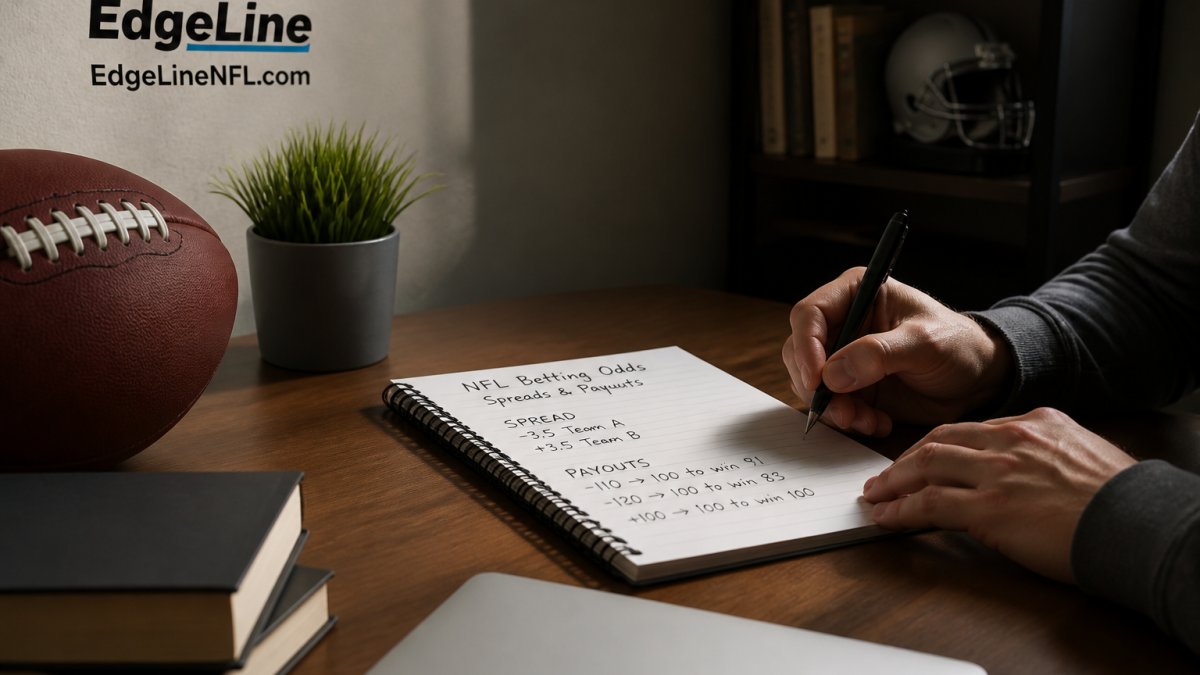
Table of Contents
- NFL Point Spread Explained: Reading Favorites and Underdogs
- How to Calculate American Odds Payout on an NFL Wager
- Implied Probability Betting Odds: Turning Lines Into Percentages
- Using an NFL Betting Odds Calculator
- Point Spread vs. Moneyline: Two Ways to Pick a Game
- Key Numbers and Why NFL Spreads Move
- Common Mistakes When Calculating NFL Betting Odds
- Conclusion
- Frequently Asked Questions
NFL Point Spread Explained: Reading Favorites and Underdogs
Learning how to calculate NFL betting odds starts with the point spread. A point spread is the number of points a sportsbook sets between two teams, designed to split betting action evenly. The favorite gives points; the underdog gets them. This guide from EdgeLine NFL breaks down the math step by step, so you can read any line with confidence.
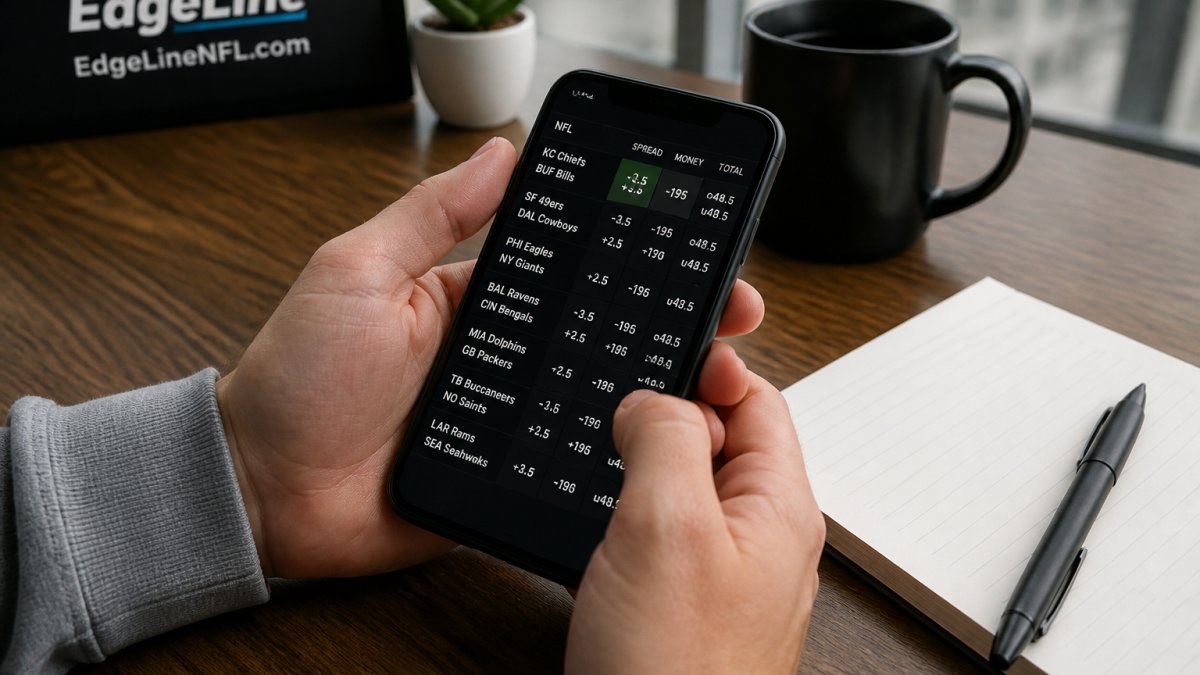
The spread number sits next to each team, like "Chiefs -3" or "Bills +3." The minus sign marks the favorite. The plus sign marks the underdog.
What the Minus and Plus Signs Mean
The minus sign means that team is expected to win by that many points. The plus sign means that team can lose by that many points and still cover.
- Favorite (-3): must win by 4 or more to cover
- Underdog (+3): covers if it wins, ties, or loses by 1 or 2
- Pick'em: no spread at all, straight winner
How to Calculate American Odds Payout on an NFL Wager
American odds show what a wager pays, and the sign in front of the number tells you which side of the $100 baseline you are on. Minus odds tell you what you must risk to win $100. Plus odds tell you what a $100 stake wins. Standard odds on most NFL spread bets sit at -110 on each side, though books will shade to -105 or -115 depending on the matchup and the action they are taking.
Here is the formula for minus odds:
Profit = (100 / odds) × stake
For plus odds:
Profit = (odds / 100) × stake
Total payout is always profit plus the returned stake. Keep those two numbers separate in your head, because a $210 return on a $110 bet is not a $210 win, it is a $100 win and your own money back.
Worked Examples: Wins, Losses, and Pushes
Say you bet $110 on a -110 spread. Your profit is $100, and the book returns your $110 stake, for $210 total. Now walk the same bet through three different final scores so the settlement rules are concrete.
Assume you took the favorite at -3 against a 3-point underdog.
- Win: the favorite wins by 7. The margin beats the spread by 4, so you collect $210. Profit: $100.
- Loss: the favorite wins by 1, or loses outright. The margin does not cover -3, so you lose your $110 stake. Profit: -$110.
- Push: the favorite wins by exactly 3. The final margin equals the spread, the bet is a push, and the book refunds your $110 stake. Profit: $0.
Now flip to the underdog at +3 in the same game.
- Win: the underdog loses by 1 or 2, ties, or wins outright. You collect $210.
- Loss: the underdog loses by 4 or more. You lose $110.
- Push: the underdog loses by exactly 3. Stake refunded.
A $50 bet at +150 wins $75 profit, for a $125 total return. A $200 bet at -110 wins $181.82 profit, for a $381.82 total return. The math scales linearly, so you can sanity-check any ticket by asking whether the profit is roughly 0.91 times the stake at -110.
Why Half-Point Spreads Matter
A push on a whole-number spread returns your stake, which sounds harmless until you realize it also wipes out a winning ticket. Half-point spreads, -3.5, +7.5, -2.5, cannot push, because no NFL final margin lands on a half point. That is why books move from -3 to -3.5 when they want to eliminate the push risk on the favorite side, and why a bettor holding a -3 ticket suddenly has a different bet than someone holding -3.5.
At EdgeLine NFL, we run these payout and settlement calculations against our fair-line projections so you can see whether the price on the screen matches the probability our analysis assigns to the matchup. Get the Edge! Subscribe Now at https://www.edgelinenfl.com.
Implied Probability Betting Odds: Turning Lines Into Percentages
Implied probability betting odds convert any line into a percentage chance. For -110, the math is 110 / (110 + 100) = 52.4%. For +150, it is 100 / (150 + 100) = 40%.
Both sides of a standard spread add up to more than 100%. That extra slice is the sportsbook's hold. Knowing this keeps you honest about what a line really says.
Using an NFL Betting Odds Calculator
An NFL betting odds calculator does the arithmetic for you. Enter the odds and stake, and it returns profit, total payout, and implied probability.
- Check the payout before you confirm any wager
- Compare implied probability across sportsbooks
- Convert moneyline prices to spread equivalents
At EdgeLine NFL, we compare live sportsbook lines against our independent fair-line projections. That shows where the market price and our model probability disagree.
Point Spread vs. Moneyline: Two Ways to Pick a Game
A point spread bet requires the team to win by a certain margin. A moneyline bet only asks who wins. Spread betting prices both sides near -110; moneyline prices the favorite much higher.
- Spread: more balanced odds, margin matters
- Moneyline: pick the winner, price reflects likelihood
- Over/under: total points, unrelated to the winner
Key Numbers and Why NFL Spreads Move
Key numbers are the final margins that show up most often in NFL games, and the two that matter most are 3 and 7. The reason is structural, not statistical luck: touchdowns plus extra points produce 7, field goals produce 3, and a game that ends on a late field goal or a touchdown with a failed two-point conversion frequently lands on those margins. Margins like 6, 10, and 14 also cluster, but 3 and 7 sit at the top because so many games are decided by a single score.
That is why a line moving from -3 to -2.5 matters more than a move from -9 to -8.5. Crossing a key number changes which side of the most common margins you are on. A bettor holding -3 pushes on a 3-point win; a bettor holding -2.5 wins that same game. The half point is not cosmetic, it is the difference between a refund and a payout.
What Actually Moves a Line
Spread adjustment follows money and news. The main drivers:
- Injury news: a starting quarterback ruled out, an offensive lineman downgraded, or a defensive starter placed on injured reserve can shift a line by a field goal or more depending on the position.
- Betting activity: books move lines to balance action and manage risk. A heavy concentration on one side pushes the number toward the other side until the book is comfortable.
- Weather: wind, rain, and snow affect passing games and kicking, and outdoor late-season games can move totals and spreads together.
- Situational factors: short weeks, travel, and divisional familiarity can nudge a number even when the rosters are unchanged.
Line movement tells you where the betting market is leaning. It does not tell you the outcome. A line that moves from -3 to -4.5 is a signal that money and information are flowing toward the favorite, but the market can be wrong, and a moved line is often a worse price than the one that was available earlier.
Reading Movement Without Overreacting
A common pattern is for a line to open, get bet hard in the first few hours, then settle as books collect more information. If you are evaluating a bet, compare the current number to the opening number and ask whether the move reflects new information (an injury, a weather forecast) or simply public money. The first is worth respecting; the second is often a reason to wait.
At EdgeLine NFL, we track market movement alongside injury-aware matchup analytics so you can see when a line has moved for a reason and when it has simply drifted. Get the Edge! Subscribe Now at https://www.edgelinenfl.com.
If you or someone you know has a gambling problem, call or text the National Problem Gambling Helpline at 1-800-522-4700. Betting involves risk, and you must be of legal age in your jurisdiction to place a wager.
Common Mistakes When Calculating NFL Betting Odds
The biggest mistake is forgetting the juice. A -110 bet needs a 52.4% win rate just to break even, not 50%.
- Confusing payout with profit
- Ignoring pushes on whole-number spreads
- Treating model probability as certainty
- Chasing a moved line without checking the new price
Conclusion
Reading NFL betting odds is a skill, and the math is simpler than it looks. Convert the line to implied probability, check the payout, and separate model probability from certainty.
EdgeLine NFL gives you fair-line projections, injury-aware matchup analytics, and market movement tracking to support that work. Get the Edge! Subscribe Now at https://www.edgelinenfl.com.
Frequently Asked Questions
What does a +7.5 point spread mean in football?
A +7.5 spread means that team is the underdog and gets 7.5 points added to its final score for spread betting purposes. If the underdog loses by 7 or fewer points, or wins outright, the +7.5 bet wins. The half point removes the possibility of a push, so the bet either wins or loses. To calculate the payout on a +7.5 underdog at standard -110 odds, a $100 stake returns about $90.91 in profit. Reading the spread number first, then the odds, keeps the math clear.
How do you calculate implied probability from NFL betting odds?
For negative American odds, divide the absolute odds by the absolute odds plus 100. At -110, that is 110 divided by 210, or about 52.4%. For positive odds, divide 100 by the odds plus 100. At +150, that is 100 divided by 250, or 40%. Adding both sides of a spread typically pushes the total above 100%, and that gap is the sportsbook's hold. Comparing your own estimated probability to the implied probability is how you spot whether a line offers value.
How do point spreads affect an NFL bet?
The point spread sets a handicap so both sides of a game can be bet at similar odds. The favorite must win by more than the spread for a favorite bet to cover, while the underdog must lose by fewer points or win outright. If the final margin equals the spread exactly on a whole-number line, the bet is a push and the stake is returned. The spread does not change who wins the game; it changes which side of the bet cashes. That distinction matters when you compare spread betting to a moneyline wager.
What is the difference between a moneyline and a point spread?
A moneyline bet picks only the outright winner, with no point adjustment. A point spread bet adds or subtracts points to create a more balanced market. In an NFL matchup, a strong favorite might be -300 on the moneyline but -7 on the spread. The moneyline pays less on the favorite and more on the underdog; the spread pays close to even on both sides at standard -110 odds. Choose the moneyline when you care only about who wins, and the spread when you have a view on the margin of victory.
Bet responsibly. Sports wagering is for adults of legal age in jurisdictions where it is permitted.