What are the best NFL bets to make?
Last Updated: October 26, 2026
Quick Summary
The best NFL bets are wagers where sportsbook odds undervalue the true probability of an outcome, not picks with high win rates. Identify edges by comparing live odds against fair-line projections, choosing the right bet type for your analysis, and tracking results systematically to verify your method actually works.
- Convert every price to implied probability first to compare bet types fairly and find the cheaper way to express your view.
- At -110 odds on a spread, you need to win 52.4% of bets just to break even; understand your break-even rate before placing any wager.
- Build player prop projections from expected volume, expected efficiency, and game script rather than reputation or recent performance alone.
- Shop odds across at least three sportsbooks because half-point differences on spreads often decide close games and compound into significant long-term ROI gains.
- Use unit-based bankroll sizing (typically 1-5% of total capital per unit) and track every bet in a journal to distinguish actual profitability from variance.
Table of Contents
- How to Identify the Best NFL Bets
- NFL Point Spread vs Moneyline: Which Bet Type Fits Your Strategy
- NFL Over Under Betting: Finding Value in Game Totals
- NFL Player Props: Evaluating Individual Performance Bets
- How to Compare NFL Odds Across Sportsbooks
- Bankroll Management and Responsible Betting
- Start Finding Your Edge at EdgeLine NFL
- Frequently Asked Questions
How to Identify the Best NFL Bets
Making the best NFL bets starts with separating a sound wager from a risky one.
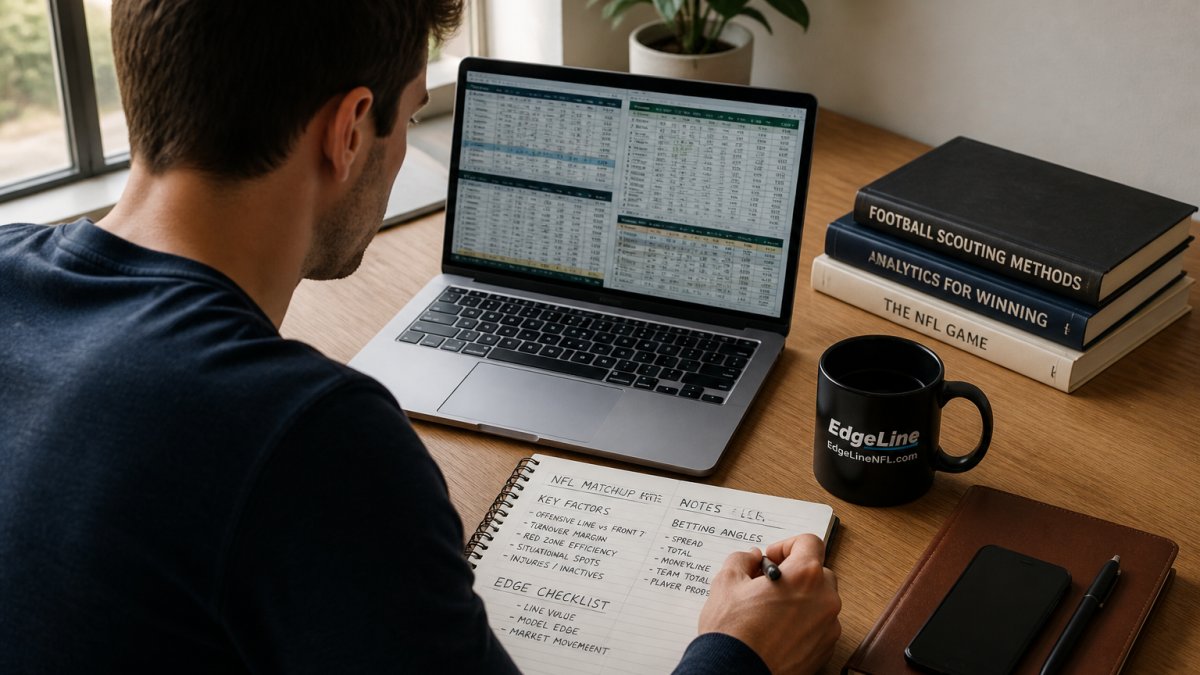
At EdgeLine NFL, we compare live sportsbook lines with proprietary fair-line projections to identify model edges.
Start by asking three questions about any potential wager:
- Does this bet align with team strengths and weaknesses in the matchup?
- Are the odds offering real value, or am I paying too much for this outcome?
- What factors could shift the outcome, injuries, weather, rest advantages?
The teams with the strongest statistical advantages aren't always the best bets if the market has already priced them in.
Tracking your picks and their outcomes matters more than most bettors realize. According to research on sports betting performance, bettors who track results systematically improve their ROI compared to casual bettors who don't.
NFL Point Spread vs Moneyline: Which Bet Type Fits Your Strategy
The point spread and the moneyline are two ways to price the same game, and the right choice depends less on confidence than on what the market charges. Most bettors pick a side first and a bet type second. Sharp bettors do the reverse: estimate a probability, convert the price to implied probability, then pick the cheaper way to express the view.
A point spread is a handicap that makes both sides roughly equally attractive. At -7, the favorite must win by more than 7 points; the underdog can lose by up to 6 and still cover.
A moneyline is a straight-up bet on which team wins, regardless of margin. A favorite at -200 means you must risk $200 to win $100. An underdog at +150 means a $100 bet wins $150.
Convert every price to implied probability first
Implied probability is the market's break-even estimate for an outcome, before the sportsbook's margin. The formulas are simple:
- Negative odds (favorites): implied probability = |odds| / (|odds| + 100). So -200 becomes 200 / 300 = 66.7%.
- Positive odds (underdogs): implied probability = 100 / (odds + 100). So +150 becomes 100 / 250 = 40.0%.
- Standard -110 spread price: 110 / 210 = 52.4%. That is the break-even win rate you need just to tread water on a -110 bet.
That last number is the one most bettors never internalize. At -110, you need to win 52.4% of spread bets to break even; at -200 on a moneyline, 66.7%; at +150, just 40.0%.
A worked comparison
Say you project a team as a 68% favorite to win outright, and the market offers -4.5 (-110) on the spread or -200 on the moneyline.
- Moneyline at -200: implied probability 66.7%. Your 68% estimate barely clears the break-even line, so any projection error erases the edge.
- Spread at -4.5 (-110): implied probability 52.4%. This bet asks whether the team wins by 5 or more. If your model says they cover 58% of the time, the spread is the better expression of the same view, a much lower break-even rate for a probability you still think you beat.
The lesson: a moneyline favorite and a spread favorite are not interchangeable. The moneyline asks you to be right about the winner; the spread asks you to be right about the margin. Whichever question your analysis answers is usually the cheaper bet.
When each bet type tends to fit
Spreads tend to fit when:
- Your edge is about margin, not just outcome, line play, pace, and matchup advantages that show up over four quarters.
- You want a lower break-even rate (52.4% at -110) and can tolerate pushes and backdoor covers.
- You are comparing many games and want consistent risk-reward across the slate.
Moneylines tend to fit when:
- You genuinely believe the market's win probability is wrong, not just the margin.
- You are taking an underdog you think is live, a +150 dog only needs to win 40% of the time to break even.
- The spread is priced at a number you cannot trust (a key number like 3 or 7 that the market has already shaded).
Watch the key numbers
Spreads cluster around 3 and 7, the most common margins of victory in pro football. A line at -3 or -7 is priced differently than -2.5 or -6.5, and a half-point move across those numbers is worth more than anywhere else. Check whether the spread sits on or off a key number, it changes what the market charges you.
Learn how to read NFL point spreads for beginners to understand the mechanics before placing money. For more advanced analysis, check out how to calculate NFL betting odds so you can compare implied probability across different bet types and identify when sportsbooks have mispriced the line.
Convert every price to implied probability to compare bet types fairly and find the cheaper way to express your view.
| Bet Type | Odds Example | Implied Probability | Break-Even Win Rate |
|---|---|---|---|
| Moneyline favorite | -200 | 66.7% | 66.7% |
| Standard spread | -110 | 52.4% | 52.4% |
| Moneyline underdog | +150 | 40.0% | 40.0% |
NFL Over Under Betting: Finding Value in Game Totals
Over/under bets (also called "totals") focus on the combined score of both teams, not the winner.
Over/under betting removes the need to pick a winner, you're predicting combined scoring, which appeals to bettors focused on game flow, pace, and efficiency rather than team quality.
Finding value in totals requires understanding what drives scoring:
- Pace of play: Faster offenses and defenses that allow quick possessions inflate totals. Slow, methodical teams deflate them.
- Offensive efficiency: Teams that convert third downs and red zone opportunities push totals higher.
- Defensive strength: Strong defenses that force punts and turnovers lower totals.
The best NFL bets on totals often come when the market overreacts to recent games.
Compare the total against both teams' season averages in scoring and points allowed.
NFL Player Props: Evaluating Individual Performance Bets
Player props isolate individual performance, passing yards, rushing yards, receptions, touchdowns, into standalone bets. The edge rarely comes from knowing a player is good. It comes from projecting volume and efficiency more accurately than the market, then checking whether the price reflects that projection.
Build the projection from usage, not reputation
A prop line is the sportsbook's estimate of a player's median outcome. To beat it, you need a projection built from three inputs:
- Expected volume. For a receiver, that means routes run and target share. For a running back, carries and targets. For a quarterback, dropbacks. Volume is the foundation, efficiency swings are noisy, but volume is sticky week to week.
- Expected efficiency. Yards per target, yards per carry, catch rate, touchdown rate. Use the player's recent role and the opponent's defensive profile, not season-long averages that may include a different role.
- Game script. A team projected to win big tends to run more and pass less in the second half. A team projected to trail passes more. Game script shifts volume, and volume shifts the prop.
Multiply expected volume by expected efficiency to get a projection, then compare it to the line. If your projection is 78 rushing yards and the line is 85, the under is the value side, assuming your inputs are sound.
A worked example
Say a receiver has averaged 8 targets per game over the last four weeks, catches about 65% of them, and faces a secondary allowing above-average catch rates to the position. Your projection: 8 targets × 0.65 ≈ 5.2 receptions. If the line is 6.5, your projection sits well under it and the under is worth a look; if the line is 4.5, the over is the side to examine.
The point is not that the projection is certain, it is that you have a number to compare against the price. A prop bet without a projection is just a hunch with a jersey attached.
Matchup and role factors that move the number
- Volume trends: Is target share or carry share stable, or has it swung week to week? Volatile usage makes props harder to project and the market harder to beat.
- Matchup difficulty: How does the opponent rank against this position? Elite cornerbacks suppress receiver yards; strong run defenses limit rushing props. Use positional matchup data, not just team defensive rank.
- Role changes: A player returning from injury may see reduced snaps even if active. A trade or coaching change can reshape target distribution overnight. Check the latest depth chart and snap counts before betting.
Why the market shades props
Sportsbooks often shade player props toward public betting patterns rather than pure probability. If a popular player is favored to score, the market may inflate that prop because the public wants the over.
Props also carry more uncertainty than sides or totals because a single player's role can change mid-game. Treat prop bets as higher-variance wagers and size them accordingly.
At EdgeLine NFL, we separate official picks from lower-confidence model leans. Get the Edge! Subscribe Now at https://www.edgelinenfl.com.
How to Compare NFL Odds Across Sportsbooks
Different sportsbooks offer different odds on the same bet.
Comparing odds across sportsbooks is how sharp bettors find consistent edges. A half-point difference on a spread often decides a close game.
Use this framework when shopping for the best line:
- Identify the bet type and amount. Know exactly what you're betting before you start comparing.
- Check at least 3 sportsbooks. Most major platforms offer similar odds, but outliers exist. The book with the best spread or moneyline today might offer worse odds next week.
- Record the best available line. Document which book offered the best odds so you can return there for future bets.
- Understand implied probability. Learn how to identify betting market edges using implied probability so you can spot when a line is genuinely mispriced versus when it's just a standard variance.
The best NFL bets often come from recognizing when one sportsbook has moved a line differently than others.
According to betting market research on line movement, sharp money typically moves lines within the first few hours after opening.
Bankroll Management and Responsible Betting
The best NFL bets mean nothing if poor bankroll management wipes out your account.
Most professional bettors use unit-based sizing.
Learn how to calculate NFL betting unit size so you can develop a bankroll strategy that matches your risk tolerance and betting volume.
Track your bets in a spreadsheet or betting journal. Record the date, bet type, line, wager amount, result, and profit/loss.
Responsible gambling means:
- Never bet more than you can afford to lose
- Set a monthly loss limit and stick to it
- Avoid chasing losses with larger bets
The best NFL bets are only valuable if you have the bankroll discipline to survive downswings and capitalize on upswings.
Start Finding Your Edge at EdgeLine NFL
EdgeLine NFL helps you do all of this by comparing live sportsbook lines against independent fair-line projections, tracking injury impacts on matchup outcomes, and maintaining a verified record of pick performance.
The difference between casual bettors and sharp bettors isn't luck, it's process. Sharp bettors compare odds across books, understand implied probability, and explore 5 NFL betting strategies that separate real edges from noise.
Get the Edge! Subscribe Now at https://www.edgelinenfl.com.
Frequently Asked Questions
What makes one NFL bet better than another?
The best NFL bets combine three factors: matchup analysis that identifies team strengths and weaknesses, probability estimates that can be compared with sportsbook lines, and tracking how a line changes toward closing. A bet isn't just about picking a winner, it's about finding situations where the odds offer genuine value over time. Data-driven platforms compare their independent fair-line projections against live sportsbook lines to spot these edges.
How do NFL point spread vs moneyline bets differ in value?
Point spread bets require your team to win by more than the spread; moneyline bets only require a win. Spreads typically carry lower odds (closer to -110) because both outcomes are roughly balanced. Moneylines pay more for favorites and less for underdogs, reflecting true win probability. Choose spreads when you're confident about margin; use moneylines when you're certain about the outcome but less sure about the margin. Understanding implied probability helps you spot which format offers better value in each matchup.
Are NFL over/under bets easier to win than side picks?
Not necessarily. Over/under bets depend on total points scored, which can be harder to predict because weather, injuries, and game script all shift totals unpredictably. They're not easier or harder, just different. The value depends on whether the sportsbook's total matches the actual probability of hitting that point total. Some bettors find totals easier because they focus on one number instead of picking a winner, but the edge comes from accurate forecasting, not the bet type itself.
Should I focus on NFL player props if I'm new to sports betting?
Player props can work for beginners, but they require detailed injury and matchup knowledge. Props on high-volume players (passing yards, rushing yards, receptions) are easier to evaluate than touchdown props, which carry higher variance. Start by learning one player type, like a quarterback's passing yards, before expanding to multiple props. The key is comparing your projection against the sportsbook line to find value, just like you would with game-level bets.
How do I know which sportsbook has the best NFL odds?
Compare the same bet across multiple sportsbooks before placing it. A half-point difference on a spread or a few cents difference in moneyline odds can swing your long-term profit.
Finding the best NFL bets requires more than picking winners. It demands understanding how odds reflect probability, recognizing when markets misprice outcomes, and managing your capital so variance doesn't destroy your account. Start with sound analysis, verify your results, and adjust your approach based on what the data actually shows, not what you hope will happen.
