Most Successful Football Betting Strategy: A Data-Driven Guide

Table of Contents
- What Makes a Football Betting Strategy Successful
- Point Spread vs Moneyline Betting Explained
- Value Betting: Finding Mispriced Odds
- NFL Bankroll Management: Staking Plans That Work
- NFL Line Shopping and Closing Line Value
- Closing Line Value: Why It Matters More Than Win Rate
- Pre-Match Research: Teams, Form, and Match Conditions
- Tracking and Backtesting Your Strategy
- Frequently Asked Questions
Last Updated: October 11, 2026
What Makes a Football Betting Strategy Successful
A successful football betting strategy combines disciplined bankroll management, rigorous research, and a clear understanding of how sportsbooks price games.
Most bettors focus on picking winners. The real edge comes from finding situations where the odds don't match the actual probability of an outcome. This is where a football betting strategy separates casual bettors from those who generate consistent returns.
At EdgeLine NFL, we track this distinction constantly. Our approach compares live sportsbook lines against proprietary fair-line projections to identify where edges exist. The bettors who win long-term aren't the ones with the highest win rate.
Point Spread vs Moneyline Betting Explained
The point spread and moneyline represent two fundamentally different ways to bet on football games, each with distinct strategic implications. Understanding when to use each market is critical to executing a coherent football betting strategy.
A point spread is a handicap applied to the favored team. If the Kansas City Chiefs are favored by 5 points, they must win by more than 5 for a spread bet on them to cash.
A moneyline bet is straightforward: pick the winner. No points involved.
When to Use Each Market
The point spread is where most sharp action occurs. Because the spread adjusts based on betting volume, it's where you'll find the most sophisticated bettors testing their models.
Moneyline betting works best for games where you have conviction about which team wins, but less certainty about the margin.
The moneyline also matters for tracking closing-line value. If you backed a team at +110 odds and it closed at -110, you beat the closing line. That metric matters more than whether you won the actual bet.
Value Betting: Finding Mispriced Odds
Value betting is the foundation of any profitable football betting strategy. It means identifying situations where the odds offered by a sportsbook underestimate the true probability of an outcome.
Here's the practical reality: sportsbooks employ sophisticated models. They're not trying to predict games accurately, they're trying to balance action and manage liability. When sharp money comes in on one side, they adjust the line.
Finding value requires comparing your own probability estimates against the implied probability in the odds. If you think a team has a 55% chance to win and the moneyline offers -110 (implying roughly 52% probability), you have value.
Calculating Probability and Expected Value
Implied probability is the probability the odds suggest. For a -110 spread bet, the calculation is: 110 / (110 + 100) = 0.524, or about 52.4% implied probability.
Expected value is your edge. If you believe a team has a 55% chance to win and the moneyline is -110, your expected value per $100 bet is: (0.55 × $100) - (0.45 × $110) = $55 - $49.50 = $5.50.
The math is straightforward, but execution is difficult. It requires honest self-assessment of your probability estimates and discipline to pass on bets where the value isn't there. Many bettors overestimate their accuracy.
NFL Bankroll Management: Staking Plans That Work
Bankroll management determines whether you survive downswings and compound gains during winning periods. Without a staking plan, even a bettor with a genuine edge can go broke during variance.
Your bankroll is the amount you've allocated specifically for betting. It should be money you can afford to lose without affecting your life. The size of each individual bet should be a small percentage of your total bankroll, ensuring that normal variance doesn't wipe you out.
Fixed Unit, Proportional, and Kelly Criterion
Fixed unit staking is the simplest approach. You bet the same amount on every game, say, 1 unit = $50.
Proportional staking ties bet size to your confidence. A play you rate as high conviction might be 3 units, while a marginal edge is 1 unit.
Kelly Criterion is the mathematically optimal staking formula: (edge % / odds) × bankroll. If you have a 5% edge and -110 odds, Kelly suggests betting about 2.5% of your bankroll.
The reality: fixed units work fine for most bettors. They're simple, they enforce discipline, and they keep you in the game during downswings.
NFL Line Shopping and Closing Line Value
Line shopping means comparing odds across multiple sportsbooks before placing a bet. Different books offer different lines, one might have the Chiefs at -5, another at -4.5.
Closing-line value measures whether you beat the odds available at the close of betting.
Bettors who consistently beat the closing line are profitable. Those who consistently lose to it are not.
The practical approach: identify a few sportsbooks with the best closing lines in your market. Before placing a bet, check if you can get better odds elsewhere.
Closing Line Value: Why It Matters More Than Win Rate
This is where most casual bettors misunderstand profitability. A bettor with a 52% win rate and poor closing-line value will lose money long-term.
Here's why: the closing line incorporates all available information. Sharp bettors have moved it. Public money has influenced it. Weather updates and injury reports are priced in.
Conversely, if you consistently lose to the closing line, you're either making poor decisions or you're betting into inflated odds that correct as more information arrives.
Track this metric religiously. For every bet, record the odds you took and the closing line. Calculate your average closing-line value. If it's positive, you have an edge.
Pre-Match Research: Teams, Form, and Match Conditions
Effective pre-match research requires analyzing team efficiency, recent form, injury impact, and environmental factors.
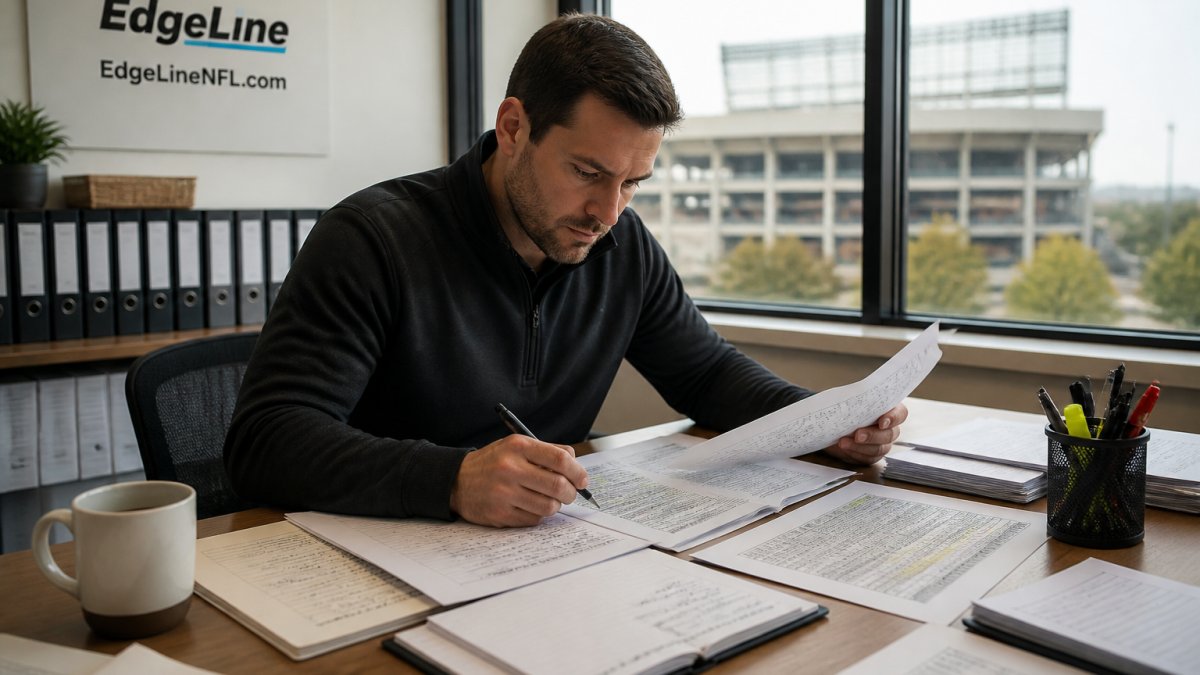
Start with team efficiency metrics. How well does each team move the ball? How effectively do they stop opponents?
Form matters, but context matters more. A team on a three-game winning streak might have faced weak opponents.
Injuries reshape matchups. A cornerstone pass rusher out changes defensive pressure rates. A starting quarterback injury shifts the entire offensive scheme.
Analyzing Team Efficiency and Injury Impact
Team efficiency is typically measured in points per play or yards per play. A team that averages 0.25 points per offensive play is more efficient than one averaging 0.20. Over a full game, that difference compounds into significant point differentials.
Injury impact varies by position. Losing a backup linebacker has minimal effect. Losing an elite pass rusher or starting cornerback reshapes defensive schemes and coverage capabilities. Evaluate injuries based on replacement-level talent available.
Weather influences play style and field conditions. Heavy wind reduces passing efficiency. Rain increases fumbles and interceptions. Extreme cold affects player performance and grip.
Tracking and Backtesting Your Strategy
Most bettors never track their results systematically. They remember the big wins and forget the small losses.
Create a simple spreadsheet. Record every bet: the matchup, the odds you took, your stake, the result, and the closing line.
Backtesting involves applying your strategy to historical data.
Backtesting has limitations. Past results don't guarantee future performance. Rule changes, personnel changes, and coaching changes alter the landscape.
Start with a small sample. Test your strategy against the current season. After 20-30 bets, evaluate the results.
The most successful football betting strategy is one you'll actually execute. Complex models fail when bettors abandon them during downswings.
At EdgeLine NFL, we provide the research infrastructure to identify edges, comparing live sportsbook lines against proprietary fair-line projections, tracking injury-aware matchup analytics, and monitoring market movement in real-time.
Frequently Asked Questions
What is the most profitable betting strategy for football?
The most profitable football betting strategy combines value betting with disciplined bankroll management and closing-line value tracking. Rather than betting on favorites or underdogs, successful bettors identify odds that don't reflect true probability. This requires comparing your own probability estimates against bookmaker odds, then staking proportionally to expected value. Over time, betting consistently on positive expected value plays, even with a 45% win rate, outperforms picking winners. Tracking your closing-line value (the odds you got versus the final line) proves whether your edge is real.
How much of your bankroll should you bet on one football game?
Professional bettors typically stake 1-5% of their total bankroll per game, depending on confidence and strategy. The fixed unit method uses the same percentage every bet. The Kelly Criterion, a mathematical formula, calculates optimal stake size based on your edge and probability estimate, but requires accurate win-rate data. For most bettors, 2-3% per game balances growth with protection against variance. Never exceed 5% on a single bet; this preserves bankroll during losing streaks and prevents catastrophic losses.
Is betting the point spread or moneyline better?
Neither is inherently better; each serves different purposes. Point spread betting offers close odds (typically -110 on both sides) and suits bettors who believe they can predict margin of victory. Moneyline betting pays different odds for favorites and underdogs, making it ideal for identifying undervalued underdogs. The best strategy depends on where you find value. If the moneyline underdog is mispriced relative to its true win probability, that's your edge. Line shopping across sportsbooks helps you find the best odds in either market.
How do you find value in NFL betting odds?
Finding value requires comparing your probability estimate against the implied probability of the bookmaker's odds. First, convert odds to implied probability (for -110 spread odds, that's roughly 52.4% for each side, accounting for margin). Next, research team efficiency, form, injuries, and matchups to estimate true win probability. If you project a team at 55% to win but odds imply 48%, that's positive expected value. Use closing-line value tracking to verify your estimates work over time. Many sharp bettors focus on line movement, if a line moves in your favor after you bet, your edge often strengthens.
Does line shopping improve your chances of winning football bets?
Yes, significantly. Line shopping means comparing odds across multiple sportsbooks before placing a bet. Even small differences (0.5 points on a spread, or -110 versus -105 on moneyline odds) compound into measurable long-term profit. If you consistently get the best available line, your closing-line value improves, and your ROI rises. A bettor who shops lines might average -108 odds instead of -110, reducing the bookmaker margin by 2%. Over 100 bets, that difference equals one additional win. For serious bettors managing large bankrolls, line shopping is non-negotiable.
What is closing-line value and why does it matter?
Closing-line value (CLV) measures the difference between the odds you received and the final odds before kickoff. If you bet a team at -110 and the line closes at -120, you achieved positive CLV. CLV matters because it's the most reliable indicator of true edge. A bettor with a 45% win rate but positive CLV is profitable over time; a 55% win rate with negative CLV eventually loses. Tracking CLV proves whether your research and predictions actually work. Professional bettors obsess over CLV because it separates luck from skill and identifies sustainable edges.
What role does bankroll management play in long-term betting success?
Bankroll management is the difference between sustainable profit and ruin. Even bettors with positive expected value face variance; a losing streak can eliminate an undercapitalized bankroll. Proper staking, typically 1-5% per bet, ensures you survive downswings and compound gains during upswings. The Kelly Criterion maximizes growth but requires precise edge estimation; most bettors benefit from conservative staking. Without limits, a single bad week can wipe out months of profit. Successful betting is 70% bankroll discipline and 30% picking winners.
How should I track my bets to prove my strategy works?
Track every bet with: date, sport, matchup, odds taken, stake, result, and closing odds. Calculate closing-line value for each bet and your cumulative ROI. Monitor win rate and average odds to identify patterns. Over 50-100 bets, you'll see whether your edge is real or random. Use spreadsheets or dedicated tracking software. Red flags include: negative CLV despite winning bets (you're lucky, not skilled), high win rate with low ROI (you're underestimating favorites), or variance swings exceeding your bankroll's capacity. Transparent tracking separates data-driven bettors from gamblers.