How to Calculate Closing Line Value

Table of Contents
- What Is Closing Line Value and Why It Matters
- The Closing Line Value Formula Explained
- How to Calculate CLV for Point Spreads
- How to Calculate CLV for Totals
- What Is a Good Closing Line Value
- Closing Line Value Calculator Spreadsheet Setup
- Beating the Closing Line: Practical Strategies
- Common Mistakes When Tracking Closing Line Value
- Frequently Asked Questions
Last Updated: October 4, 2026
What Is Closing Line Value and Why It Matters
Closing line value is the difference between the odds you get when you place a bet and the final odds at the sportsbook when the game starts. It measures whether you beat the market or lost to it. This metric separates profitable bettors from the rest because it's the only measure that actually reflects your edge over time.
Most bettors track wins and losses. That's the wrong metric. You can win bets at bad prices and lose bets at great prices. Over hundreds of wagers, closing line value is what determines long-term profitability. Sharp bettors obsess over it. Casual bettors ignore it. That's the gap.
The Core Concept
When you place a bet at -110 (standard vig) and the closing line moves to -115, you got worse odds than the market consensus. That's negative closing line value. When you bet at -110 and the line closes at -105, you beat the market. That's positive closing line value, and it's what separates winners from losers.
The closing line represents the aggregate judgment of all smart money in the market. Bookmakers, sharp bettors, and algorithms all converge on a final price. If you consistently beat that price, you have an edge. If you consistently lose to it, you don't, no matter what your win rate looks like.
Why Closing Line Value Is the Gold Standard
Winning individual bets feels good. Winning bets at bad prices doesn't mean much. Closing line value removes the illusion. It answers the only question that matters: did you identify value before the market corrected itself?
Consider two scenarios. You bet the Cowboys at -110 and they win 28-21. Great. But what if the closing line was -120? You got lucky on a bad bet. Now imagine you bet the Cowboys at -110 and they lose 21-28. Terrible.
This is why professional handicappers, high-volume bettors, and data-driven shops all track closing line value. It's the performance metric that actually predicts future success. Win rate doesn't. Accuracy on predictions doesn't. Only closing line value reveals whether you're beating the sportsbooks or the sportsbooks are beating you.
The Closing Line Value Formula Explained
Basic CLV Calculation
The math is simple. Take your entry odds and compare them to the closing odds. The formula depends on which odds format you're using.
For decimal odds: CLV = (Entry Odds - Closing Odds) / Closing Odds × 100
For American odds, convert first, then calculate: CLV = (Entry Decimal - Closing Decimal) / Closing Decimal × 100
If your result is positive, you beat the line. If it's negative, the line beat you. Over 100 bets, even a small positive CLV compounds into significant profit.
Decimal vs. American Odds Conversion
Most U.S. sportsbooks display American odds. Professional bettors convert to decimal for easier math. The conversion is straightforward.
American to Decimal:
- Positive odds (e.g., +150): Divide by 100, then add 1. So +150 becomes 2.50.
- Negative odds (e.g., -110): Divide 100 by the absolute value, then add 1. So -110 becomes 1.909.
Decimal to American:
- Above 2.0: Subtract 1, then multiply by 100. So 2.50 becomes +150.
- Below 2.0: Divide -100 by (decimal - 1). So 1.909 becomes -110.
Keep a conversion chart open when you're starting out. After tracking fifty bets, the conversions become automatic. This is foundational work. Get it right.
How to Calculate CLV for Point Spreads
Point spreads are the most common betting market. The closing line value calculation is identical to the formula above, but context matters.
When you bet a team at -110 and the line closes at -115, you lost 5 cents of value. Over 100 bets at that spread, that's significant leakage.
The key insight: line movement tells you whether the market agreed with you or disagreed. If you bet the Cowboys at -3.5 (-110) and the line moves to -4.0 (-110), the market is now more bearish on the Cowboys than you were. Your closing line value is negative.
Track this obsessively. Over a full season, bettors who consistently beat closing lines on spreads see measurable profit. Those who consistently lose to closing lines see measurable losses, even if their picks are directionally correct.
How to Calculate CLV for Totals
Totals (over/under) work the same way mathematically, but the market dynamics differ slightly. Totals attract different sharp money than spreads. Some games have tight consensus on totals. Others have wide disagreement.
When you bet the over at 47.5 (-110) and the closing total is 48.5 (-110), you lost value. The market moved away from your entry price. When you bet the over at 47.5 and the closing total is 47.0, you gained value.
The challenge with totals: closing line value can be harder to track because closing times vary. Some books move their totals late. Some lock in early. Use the official closing line from a reputable source like Covers closing lines database to ensure consistency.
What Is a Good Closing Line Value
Benchmarking Your Performance
A closing line value of +0.5% is solid. That means for every 100 bets, you're gaining half a cent of value per wager. Over a year with volume, that compounds.
Professional bettors often target +2% to +5% CLV. That's difficult. It requires consistent edge identification and disciplined execution. Most casual bettors are at -1% to -2% CLV, which explains why most casual bettors lose money.
Here's the benchmark framework:
- +3% or higher: You're beating the market consistently. This is professional-grade performance.
- +1% to +3%: You're finding value regularly. This generates long-term profit.
- 0% to +1%: You're breaking even on odds quality. Wins and losses depend on accuracy.
- -1% to 0%: You're slightly worse than break-even on odds. You need strong picks to stay profitable.
- -2% or lower: You're consistently losing value. Your picks need to be extremely accurate to offset the vig.
Sample Size and Statistical Significance
Closing line value means nothing on five bets. It means something on 50 bets. It means everything on 500 bets.
With fewer than 30 bets, variance dominates. A lucky streak or unlucky stretch will distort your CLV. At 50 bets, you're starting to see signal. At 100 bets, the signal is clearer. At 500 bets, you know whether you have an actual edge or just got lucky.
This is why tracking matters. You need volume to validate that your CLV isn't just noise. Many bettors quit tracking after 20 bets because they got unlucky. They never discover whether they actually have an edge.
Closing Line Value Calculator Spreadsheet Setup
Building Your Tracking Sheet
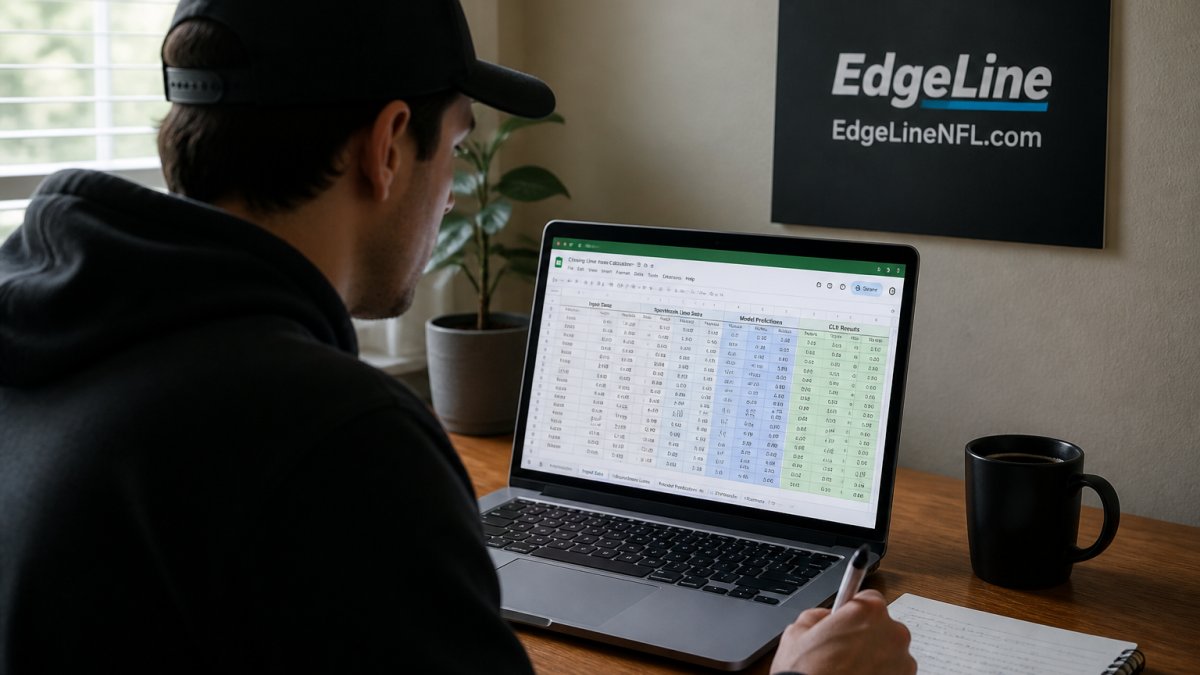
Start simple. You need five columns: date, bet, entry odds, closing odds, and CLV result.
The structure:
- Column A: Date of bet
- Column B: What you bet (team, spread, total)
- Column C: Entry odds (in decimal format)
- Column D: Closing odds (in decimal format)
- Column E: CLV formula = (C - D) / D
Add one row per bet. After each bet, calculate CLV. After 20 bets, you'll see whether you're beating or losing to closing lines.
Don't overcomplicate it. Fancy spreadsheets with color coding and charts feel professional but don't improve your betting. The data matters. The tracking matters. The presentation doesn't.
Automated Tracking Workflows
Once you have 50 bets logged, consider automating. Many platforms now pull closing line data automatically. If you use a betting app or sportsbook with an API, you can export your bets directly into a spreadsheet.
The benefit: no manual entry errors. The tradeoff: setup takes time. For casual bettors, manual tracking is fine. For serious bettors managing large bankrolls, automation saves hours and eliminates transcription mistakes.
At EdgeLine NFL, we track closing line value across all official picks. This approach reveals whether our fair-line projections beat the closing consensus. That's how we validate that our model edges are real, not just backtested illusions.
Beating the Closing Line: Practical Strategies
Market Efficiency and Line Movement
The closing line is efficient most of the time. That's the bad news for bettors. The good news is it's not always efficient. Market inefficiencies exist. They're just small and temporary.
Line movement tells you when the market is correcting. If you bet the Cowboys at -3.5 and the line moves to -4.0, the market is disagreeing with you. That's valuable information. It tells you that sharp money or public money shifted the consensus. Your entry price was better than the closing price.
The strategy: bet early when you have conviction. If the line moves toward your position, you won. If it moves away, you lost value. Over time, bettors with strong early opinions who bet before the market agrees will accumulate positive closing line value. Bettors who wait until consensus forms will accumulate negative closing line value.
CLV in Live Betting
Live betting creates unique opportunities and risks. The closing line for live bets is the moment the game ends. That means you have real-time feedback on whether you're beating or losing to the market.
In live betting, line movement is extreme and fast. The closing line value can swing 5-10 cents per second. This creates both edges and dangers. Sharp bettors exploit live inefficiencies before the market corrects. Casual bettors get caught chasing moves that already happened.
Track live betting CLV separately. It often differs from pre-game CLV because the dynamics are different. Some bettors excel at live value. Others consistently lose to it. The data will tell you which you are.
Common Mistakes When Tracking Closing Line Value
Mistake 1: Using the wrong closing line. Some bettors use their own sportsbook's closing line.
Mistake 2: Mixing odds formats. Don't calculate CLV with American odds directly. Convert to decimal first.
Mistake 3: Ignoring variance. After five bets, your CLV is meaningless. After 50 bets, it's starting to mean something.
Mistake 4: Confusing CLV with accuracy. You can have 60% accuracy and negative CLV if you're betting bad prices.
Mistake 5: Not tracking live bets. Many bettors skip live betting in their CLV calculation. That's a blind spot.
Mistake 6: Betting without knowing the closing line. Some bettors never check what the line closed at.
Closing line value is the only metric that separates betting skill from luck. Start tracking today.
At EdgeLine NFL, we believe transparent, tracked performance is the only credible measure. Real market performance with real closing line value. Learn how EdgeLine NFL tracks verified performance data to see how professional-grade closing line value tracking works in practice.
Start your own tracking sheet today. The discipline of measurement will improve your betting faster than any prediction ever could.
Frequently Asked Questions
What is closing line value?
Closing line value measures the difference between the odds you received when you placed a bet and the odds at market close. If you bet at -110 and the line closed at -120, you got positive closing line value because you received better odds than the market consensus. CLV is the gold standard metric for evaluating long-term betting performance because it isolates your ability to identify value independent of the outcome.
What is a good closing line value?
A good closing line value is typically +2% to +5% or higher over a large sample of bets (100+ wagers). Even small positive CLV compounds significantly over time. Professional bettors often target +3% to +4% CLV as a realistic, sustainable edge. However, sample size matters, variance means small samples can show high CLV by luck. Track at least 50-100 bets before evaluating your true edge.
How do you calculate closing line value for point spreads?
For point spreads, convert both your entry odds and closing odds to implied probability, then calculate the difference. Example: You bet a -110 spread (52.4% implied probability) and it closed at -120 (54.5% implied probability). Your CLV is 52.4% minus 54.5%, or -2.1%, meaning you received worse odds than the closing line. Use an odds converter to translate American odds to decimal or implied probability for easier calculation.
Why should I track closing line value instead of just win-loss record?
Your win-loss record depends partly on variance and luck. Closing line value measures whether you consistently identified value before the market corrected. You can lose bets with positive CLV and win bets with negative CLV, but over time, positive CLV bettors profit while negative CLV bettors lose. CLV reveals whether your edge is real or just a lucky streak.