How to Spot NFL Betting Edges in 2026
Table of Contents
- Step 1: Master Implied Probability and How to Calculate Betting Value
- Step 2: Read NFL Betting Line Movement Before It Moves Against You
- Step 3: Use NFL Injury Report Betting Impact to Find Mispriced Lines
- Step 4: Track Closing Line Value to Validate Your Process
- Step 5: Shop Lines Across Multiple Sportsbooks
- Step 6: Build a Bankroll Management Plan That Survives Variance
- Step 7: Avoid Psychological Biases That Kill NFL Betting Edges
- Conclusion: Turning Process Into Profit
- Frequently Asked Questions
Last Updated: October 7, 2026
Step 1: Master Implied Probability and How to Calculate Betting Value
Learning how to spot NFL betting edges starts with one number: the implied probability hiding inside every line. Sportsbooks sell prices, and every price carries a built-in expectation of how often that outcome should win.
Implied probability is the chance of an outcome expressed by the odds. If a team is priced at -150 on the moneyline, the implied probability is 150 divided by 250, which comes to 60%.
That math matters because the sportsbook's number includes its margin, or vig.
Converting Odds to Implied Probability
Negative odds: divide the odds by (odds + 100). Positive odds: divide 100 by (odds + 100). Run it on every line before you bet. A -110 spread implies 52.4%, meaning you must win slightly more than half the time just to break even.
Finding Your Edge: Actual vs. Implied Probability
The gap between your estimated probability and the implied probability is your edge. If you price a team at 65% but the market says 60%, you have a 5-point edge. Casual bettors bet on who they think wins; sharp bettors bet on who is priced wrong.
Step 2: Read NFL Betting Line Movement Before It Moves Against You
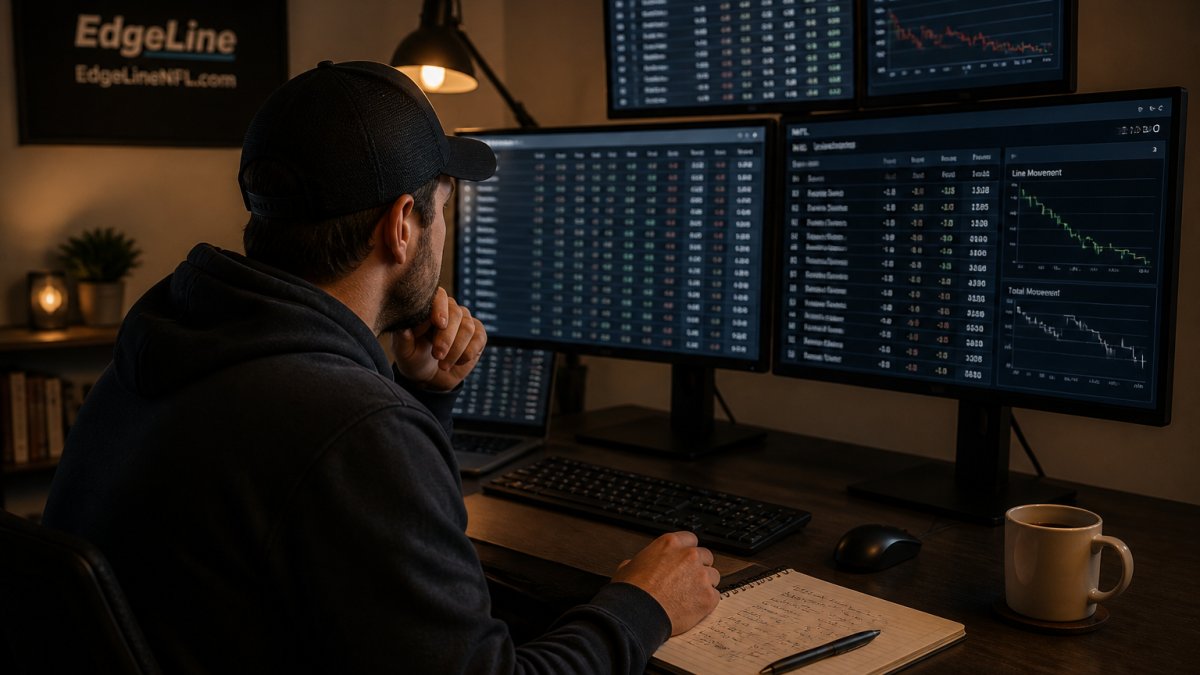
NFL betting line movement is the market's feedback loop. When a line shifts, money is talking, and the direction tells you where professional bettors are leaning. Not all movement is equal: some comes from public money piling onto a popular team, while other moves come from sharp action sportsbooks respect enough to adjust for. Telling them apart is where real edges live.
Steam Moves vs. Reverse Line Movement
A steam move is a fast, coordinated shift across multiple sportsbooks at once, usually signaling sharp money hitting the market hard. Reverse line movement is stranger: the public bets heavily on one side, but the line moves the other way, meaning the books respect the money they are not showing you. Track both, a line opening at -3 and closing at -4.5 tells a story about how the market repriced the game.
Step 3: Use NFL Injury Report Betting Impact to Find Mispriced Lines
NFL injury report betting impact is where lazy bettors lose and prepared bettors win. The edge is not in knowing a player is out, but in knowing how much that player matters to the line. A backup quarterback change can swing a spread by several points; a starting guard rarely moves it much, even though casual bettors overreact.
Read the report with a filter:
- Which positions touch the ball most?
- Is the replacement a proven starter or a career backup?
- Does the team's scheme lean on that player heavily?
- Has the market already adjusted, or is it slow?
Teams that run the ball heavily feel a running back injury differently than pass-first offenses. Context decides the size of the adjustment.
Step 4: Track Closing Line Value to Validate Your Process
Closing line value is the single best way to know whether your process works, even before the wins and losses sort themselves out. If you bet a team at -3 and it closes at -4, you got the better number, positive CLV. Bet at -4 and close at -3, and you took the worse price.
Why CLV Beats Win-Loss Record as a Success Metric
Win-loss record is noisy over a single season; variance can make a good bettor look bad and a lucky one look brilliant. CLV smooths that out. Consistently beating the closing number signals your estimates are sharper than the market's, long before your bankroll confirms it.
American Gaming Association research on sports betting shows how large and efficient the regulated market has become, which makes beating the closing line harder every year.
Step 5: Shop Lines Across Multiple Sportsbooks
Line shopping is the most reliable edge in NFL betting because it requires no prediction at all. You are not forecasting the game, you are refusing to accept a worse price for the same bet.
Start with the break-even math. At -110, you need to win 52.4% of bets to break even. Move to -105 and the break-even drops to 51.2%; move to -115 and it climbs to 53.5%. Over a 500-bet season at $100 per bet, consistently taking -105 instead of -115 is roughly $1,000 in expected value, before a single game outcome is decided.
How to Shop Lines Without Wasting Your Sunday
The practical barrier is time, not willingness. Most bettors know they should compare prices but default to the first app they open. A workable routine:
- Pick three to five regulated sportsbooks and stay loyal to them. More accounts do not help if you never check them; three is the practical minimum, five the point of diminishing returns.
- Use a line-comparison tool rather than opening each app. Odds-comparison sites aggregate current prices so you see the best available number in one view, the single biggest time-saver.
- Shop the specific market you are betting, not the game. The best price on a spread is often at a different book than the best price on the total or moneyline.
- Note which books hang softer numbers. Some adjust slower on injury news or public-heavy games, so the best number sits there before the market catches up.
- Bet early when you have conviction, late when you are shopping. If you have identified value, take the best current price; if still deciding, waiting for the market to settle often produces a better number, but only if you are not chasing.
The Half-Point That Decides Seasons
NFL games land on the key numbers, 3 and 7, far more often than any other margin, because a field goal is worth 3 and a touchdown plus extra point is worth 7. A line of -3.5 versus -3 is not cosmetic; it is the difference between a push and a loss on a meaningful share of games. Buying a half-point off a key number at a reasonable price, or finding a book already hanging the better side, manufactures an edge without changing your prediction.
The best NFL betting edges are frequently not exotic predictions. They are the best available price on a bet you already wanted to make, captured consistently, across hundreds of bets, until the margin compounds into profit.
Step 6: Build a Bankroll Management Plan That Survives Variance
Bankroll management is the difference between a strategy and a gamble. Even a bettor with a real edge will hit losing streaks, and the plan keeps you in the game long enough for the edge to pay off.
A common approach is flat betting: risk the same percentage of your bankroll on every play, usually 1% to 3%. A "unit" is your standard bet size, if your bankroll is $2,000 and your unit is 2%, you risk $40 per play. Consistent units let you measure ROI honestly.
- Never chase losses with bigger bets.
- Adjust unit size only when your bankroll changes meaningfully.
- Track every bet, win or lose.
- Separate your betting bankroll from your regular money.
Step 7: Avoid Psychological Biases That Kill NFL Betting Edges
Most edge-hunting content treats psychology as a footnote. That is backwards. A bettor with a real mathematical edge and no bias controls will still lose money, because biases attack your execution, not your model: they make you bet more on games you feel strongly about, skip boring bets, and reinterpret losses as bad luck. The edge never compounds. What separates bettors who survive a full season is rarely a better projection, it is a set of rules that override the moment a bias is about to decide for you.
The Four Biases That Cost NFL Bettors the Most
Recency bias. The mind weights last week far more heavily than it should.
Fandom bias. Betting your favorite team is the most expensive habit in the sport, because you are pricing your feelings, not the game.
Confirmation bias. Once you decide a team is good, you read only takes that agree, noticing the injury that helps your position and ignoring the one that hurts it.
Loss chasing. The urge to double the next bet to 'get it back' turns a normal losing streak into a bankroll-ending one.
Why This Is an Edge, Not Just Discipline
Here is the angle most articles miss: bias resistance is itself a source of edge, because it lets you exploit the biases of others. When the public overreacts to a primetime blowout, the line moves further than performance justifies; when a popular team draws lopsided public money, the other side is often priced better than it should be. Biases are not just personal weaknesses to manage, they are predictable market inefficiencies you can price, and the disciplined bettor is trading against the undisciplined ones.
National Council on Problem Gambling resources offers tools for keeping betting recreational and within limits.
Conclusion: Turning Process Into Profit
Spotting edges is a process, not a hunch: implied probability, line movement, injury analysis, closing line value, and disciplined bankroll management.
At EdgeLine NFL, our independent fair-line projections compare live sportsbook lines against our own model, so you can see where the market and the math disagree. Injury-aware matchup analytics fold team efficiency and weather into every projection, and our automated market movement tracking keeps you updated when lines shift. Every official pick comes with transparent, verified performance tracking, so you can judge the results yourself.
Unlock Member Picks →
Frequently Asked Questions
How do you calculate the house edge on an NFL bet?
Convert each side of the moneyline to implied probability, then add them together. If the total exceeds 100%, the excess is the vig. For example, -110 on both sides equals 52.38% implied probability each, totaling 104.76%. The 4.76% over 100% is the house edge. Standard -110 lines carry roughly a 4.5% to 5% hold. Knowing this baseline lets you identify when a sportsbook is charging more or less than standard juice.
How can you tell if an NFL bet has value?
Compare the sportsbook's implied probability to your own estimated probability. If you calculate a team has a 55% chance to win but the line implies only 48%, that gap is your edge. Value betting requires you to be more accurate than the market, not just disagree with it. Track your results over 100+ bets to confirm whether your probability estimates consistently beat the closing line.
How do injuries affect NFL betting lines?
Injury news moves lines because it changes expected team performance. A starting quarterback ruled out can shift a spread by 3 to 7 points depending on the backup's quality. The market reacts fast to official reports, but edges appear when you assess an injury's impact more accurately than the consensus. Monitoring practice reports and beat writer updates before lines fully adjust gives you a timing advantage.
How can you track NFL betting results over time?
Log every bet with the odds, stake, and closing line. Calculate your ROI by dividing net profit by total amount wagered. Track closing line value separately: if you consistently beat the closing number, your process is sound even during losing streaks. A sample of 200+ bets gives a clearer picture than short-term win-loss records, which are heavily influenced by variance.