7 Line Shopping vs Arbitrage Betting Truths Bettors Miss

Last Updated: October 29, 2026
Quick Summary
Line shopping means taking the best available odds on a single outcome across multiple sportsbooks, while arbitrage betting means backing every outcome of one event across books so the combined prices lock in a profit regardless of who wins. Line shopping improves the price on a wager you already chose; arbitrage tries to eliminate the outcome entirely.
- Line shopping is a repeatable habit, while arbitrage is a short-lived opportunity.
- An arb exists when the implied probabilities of both prices add up to less than 100%.
- Stake allocation equalizes the payout; betting equal amounts can turn a sure thing into a loss.
- Arbitrage carries execution and settlement risks, including rejected legs and frequent account restrictions.
- Choose line shopping if you have one or two funded accounts or limited time per week.
Table of Contents
- Line Shopping vs Arbitrage Betting: The Core Difference
- How to Compare Sportsbook Odds Without Wasting an Hour
- A Sports Betting Arbitrage Example You Can Follow Step by Step
- What an Arbitrage Betting Calculator Actually Does
- NFL Betting Line Movement and Why Arbs Disappear
- Risks, Account Limits, and Execution Problems Compared
- Which Strategy Fits Your Bankroll and How EdgeLine Helps
- Frequently Asked Questions
Line Shopping vs Arbitrage Betting: The Core Difference
Line shopping and arbitrage betting are two different ways to attack the same problem: sportsbooks price the same event differently. Line shopping means taking the best available odds on a single outcome across multiple sportsbooks. Arbitrage betting means backing every outcome of one event across sportsbooks so the combined prices lock in a profit regardless of who wins.
That distinction matters: line shopping is a repeatable habit, while arbitrage is a short-lived opportunity. One can improve the price on a wager. The other looks like free money until execution risks arise.
Arbitrage betting is a tactic that depends on the math and the execution both holding up.
How to Compare Sportsbook Odds Without Wasting an Hour
The fastest way to compare sportsbook odds is to pick three to five books, check the same market on each, and record the best price for every outcome side by side. Do that once per game you care about, not once per hour.
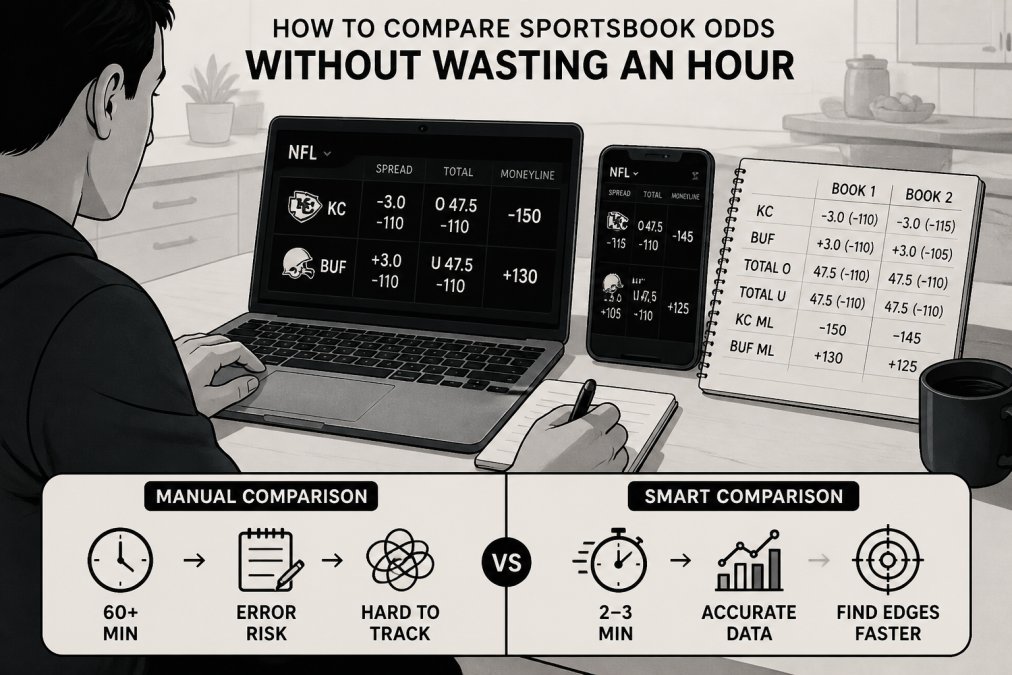
A practical routine:
- Open your books in the same order every time so you do not lose track
- Check the spread, moneyline, and total for each game you plan to bet
- Write down the best price for each side, not every price
- Note the time you checked, because odds movement is constant
A consistent record can help you spot when a number has drifted.
If you want software that tracks closing-line value and model edges automatically, our breakdown of the best sports betting software for CLV and model edges covers what to look for.
A Sports Betting Arbitrage Example You Can Follow Step by Step
A sports betting arbitrage example works like this: two sportsbooks disagree on the same game, and you split your stake across both outcomes so the payout is larger than your total outlay. The math decides whether the gap is real.
Arbitrage betting is the practice of placing wagers on every possible outcome of an event at odds that guarantee a return above your total stake, regardless of the result.
Here is the structure, using American odds on a two-way market:
- Book A offers +105 on Team A
- Book B offers +115 on Team B
- You calculate the implied probability of each price
- If the two implied probabilities add up to less than 100%, an arb exists
- You allocate your stake so both outcomes return the same amount
Running the numbers on a $100 total stake
Convert each American price to implied probability. For a positive price, the formula is 100 divided by (odds + 100).
- +105 implies 100 / 205 = 0.4878, or 48.78%
- +115 implies 100 / 215 = 0.4651, or 46.51%
- The sum is 95.29%, which is below 100%, so the arb is live
The arbitrage percentage is 95.29%. Your theoretical profit margin is 100% minus 95.29%, or 4.71% of total stake. On a $100 outlay, that is about $4.71 in locked profit if both bets fill at those prices.
Now split the stake so both outcomes pay the same. The standard allocation is total stake multiplied by each implied probability divided by the sum of implied probabilities:
- Team A stake: $100 × (48.78 / 95.29) = $51.19
- Team B stake: $100 × (46.51 / 95.29) = $48.81
Check the payouts:
- If Team A wins at +105: $51.19 × 2.05 = $104.94 returned
- If Team B wins at +115: $48.81 × 2.15 = $104.94 returned
Either way you collect about $104.94 on a $100 outlay, roughly $4.94 gross, or about $4.71 net after rounding. That is the whole point of arbitrage: the result does not matter, only the price gap does.
The same event through a line-shopping lens
Now imagine you only want to bet Team A and you are not trying to cover both sides. Book A has +105 and Book B has +115. Line shopping says take the +115 at Book B. On a $100 bet, +105 returns $205 and +115 returns $215, a $10 difference on the same wager with the same risk. That is not a guaranteed profit; it is a better price on a bet you were already making. If Team A loses, you lose either way.
That contrast is the cleanest way to see the difference. Arbitrage tries to eliminate the outcome. Line shopping tries to improve the price on an outcome you have already chosen.
Stake allocation is the part people get wrong. You are not betting equal amounts. You are betting amounts that equalize the payout. Get that backwards and a "sure thing" turns into a loss on one side.
To run the numbers yourself, our betting calculators for spreads, moneylines, and ROI handle the stake split and implied probability for you.
What an Arbitrage Betting Calculator Actually Does
An arbitrage betting calculator converts odds into implied probabilities, sums them, and tells you whether the total falls below 100%. If it does, the calculator returns the stake split that equalizes your payout across outcomes.
Three things it does not do:
- It does not place the bets for you
- It does not guarantee the odds stay put while you click
- It does not account for settlement rules that differ between books
If two sportsbooks grade a market differently, your pair of bets can turn into one winner and one void. Always read the house rules on the market before you commit.
Watch out: stale odds can undermine an arbitrage calculation.
NFL Betting Line Movement and Why Arbs Disappear
NFL betting line movement can cause arbitrage windows to close. When a line shifts, the price gap you found may disappear before both bets are confirmed.
Books may adjust their lines, and one of your two prices may change while you calculate your stake split.
Arbitrage opportunities depend on the prices available when you place the bets. A price gap can change before both bets are placed.
Our guide to NFL line movement, openers, and key numbers explains why crossing 3 or 7 changes the math and how to compare opening and current lines responsibly.
Risks, Account Limits, and Execution Problems Compared
The risks of these two strategies differ. Arbitrage betting can involve execution and settlement risks.
| Risk | Line Shopping | Arbitrage Betting |
|---|---|---|
| Odds change before bet lands | Low impact | Can break the arb |
| Rejected or limited bets | Rare | Common |
| Account restrictions | Unlikely | Frequent |
| Settlement rule mismatch | Minor | Can void a leg |
| Time required | Moderate | High per play |
Sportsbook restrictions are a possible concern. Review each sportsbook's terms and account policies.
Execution risk matters: if one leg is rejected, you may be left with a wager on only one outcome.
This is where closing line value matters more than any single result. If you want to understand why beating the closing price is the cleaner measure of skill, read our explainer on why closing line value matters for bettors.
Which Strategy Fits Your Bankroll and How EdgeLine Helps
Line shopping involves comparing prices on a wager. Arbitrage betting involves placing bets on opposing outcomes and carries execution risks.
Here is a decision framework you can actually apply:
- Choose line shopping if you want to compare prices on a wager. A better price on the same wager changes the potential return, but does not change the outcome of the bet.
- Choose arbitrage only when the gap is clear, both books are ready, and you can account for execution risk. A rejected leg can leave you with a wager on only one outcome.
- Use both by comparing prices and checking whether the available odds create an arbitrage opportunity.
Matching the strategy to your situation
| Your situation | Better fit | Why |
|---|---|---|
| One or two funded accounts | Line shopping | Arbitrage needs multiple books to find gaps |
| Limited time per week | Line shopping | A consistent record beats frantic checking |
| Multiple books, fast execution | Both | Arbs become viable, shopping stays the baseline |
| Account longevity is a priority | Line shopping | Arb patterns draw limits and closures |
| You want locked-in returns | Arbitrage (with caution) | Only when both legs fill at the quoted prices |
Comparing prices can reveal a gap between opposing outcomes. Whether it creates an arbitrage opportunity depends on the available odds and execution.
At EdgeLine NFL, we compare live sportsbook lines against independent fair-line projections, flag model edges with tiered confidence, and track market movement and closing-line value automatically. We separate official picks from lower-confidence leans. That context can inform your assessment of a price or gap.
Get the Edge! Subscribe Now at https://www.edgelinenfl.com.
Frequently Asked Questions
What is the difference between line shopping and arbitrage betting?
Line shopping means checking several sportsbooks for the best available odds on one outcome, then placing a single bet at the best price. Arbitrage betting means placing bets on every opposing outcome across different sportsbooks when the prices create a potential arbitrage opportunity. Line shopping can improve the price on a normal wager. Arbitrage betting aims to balance returns across outcomes, but it adds execution risk because prices can change before every leg is placed.
Does arbitrage betting guarantee a profit?
An arbitrage calculation indicates a potential profit only if every leg fills at the price used in the calculation and the bets are settled as expected. Lines can move and bets can be rejected, creating execution risk. Treat an arb as a calculated opportunity, not a guaranteed profit, and never stake money you cannot afford to lose.
Is line shopping useful for NFL betting?
Yes. Comparing prices can help you identify the best available odds for a wager. EdgeLine NFL tracks market movement and closing-line value; visit www.edgelinenfl.com for more information.
Can line shopping and arbitrage betting work together?
They can. Comparing prices across sportsbooks can help you identify potential arbitrage opportunities. Prices can change, and arbitrage involves execution risk. EdgeLine NFL tracks market movement and closing-line value. Get the Edge! Subscribe Now at https://www.edgelinenfl.com.
